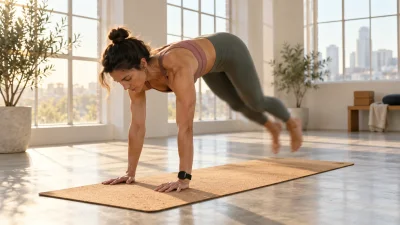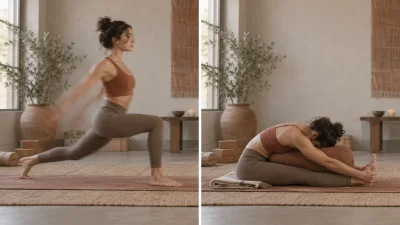
There is a familiar scene at the beginning of many yoga journeys. A new student unfolds a mat, looks around the room, and immediately begins measuring.
That person can reach the floor. This person can balance on one leg. Someone near the window appears capable of folding their body into carry-on luggage. Meanwhile, the beginner is negotiating with a hamstring that has not accepted new terms since high school.
This is usually the moment when the thought arrives: "I am not flexible enough for yoga."
It sounds reasonable. It is also backward.
You do not need to become flexible before beginning yoga any more than you need to become strong before lifting your first weight. Flexibility may develop through practice, but it is not the admission price. More importantly, it is only one small way to measure progress.
Real beginner yoga progress may look like breathing without rushing, balancing with less panic, noticing tension earlier, using a block without embarrassment, or returning to the mat after a difficult week. None of those achievements will necessarily photograph well. All of them matter.
You Do Not Need to Be Flexible to Start Yoga
Yoga is often marketed through its most visually dramatic moments. Social media favors deep backbends, overhead leg extensions, floating arm balances, and poses performed on suspiciously beautiful beaches. It rarely celebrates the student who finally remembers not to hold their breath in Warrior II.
But physical postures are only one part of yoga. The practice also involves attention, breathing, balance, strength, relaxation, and an evolving awareness of how the body feels in the present moment.
Harvard Health Publishing describes yoga as a practice that develops inner awareness and directs attention toward what the body can do now, rather than treating physical appearance as the objective. The National Center for Complementary and Integrative Health also notes that yoga may support general wellness through stress relief, healthier habits, emotional well-being, sleep, and balance.
That broader definition changes the beginner's assignment. Your first job is not to reproduce the instructor's shape perfectly. It is to learn what the pose is asking, determine what version is appropriate for your body, and remain attentive while you practice it.
A pose is not a test of your worth. It is information.
Flexibility Is an Outcome, Not a Personality Type
People often talk about flexibility as though it were a permanent identity. One person is "naturally flexible." Another is "just tight." The first belongs in yoga. The second belongs somewhere near the back of the room apologizing to their hips.
In reality, mobility and flexibility vary by joint, activity, anatomy, training history, injury history, age, and daily habits. A runner may have excellent ankle control but limited hip rotation. A desk worker may struggle to extend the upper back. A strong lifter may feel restricted in one position while demonstrating remarkable stability in another.
Yoga can help improve flexibility over time, but progress is rarely uniform. Your shoulders may open before your hamstrings change. One side may feel different from the other. Some poses may remain challenging because of individual anatomy, not because you failed to work hard enough.
This is why forcing yourself deeper is not a reliable strategy. A bigger shape is not automatically a better shape. Safe yoga practice depends on control, appropriate range of motion, steady breathing, and the ability to respond to discomfort before it becomes pain.
The beginner who stays within a manageable range is not doing less yoga. That beginner may be practicing more awareness than the experienced student who pushes past every warning sign.
Seven Better Ways to Measure Yoga Progress
1. You Notice Your Breathing
One of the earliest signs of progress is also one of the quietest: you notice when your breathing changes.
Perhaps you recognize that you hold your breath during balance poses. Maybe your breathing becomes shallow when a sequence speeds up. Over time, you learn to slow down, soften unnecessary tension, or leave a pose before your breath becomes strained.
This is not decorative breathing added to a workout. Breath can function as feedback. When it becomes jagged or forced, the body may be working beyond the level you can currently manage with control.
Yoga breathing does not have to be elaborate. For a beginner, progress may simply mean inhaling and exhaling comfortably while moving.
2. Your Balance Becomes More Responsive
Progress in balance does not mean never wobbling. It means becoming better at responding when you wobble.
You may place your foot down more calmly. You may focus your eyes on one steady point. You may learn that gripping the floor with your toes makes balancing harder, not easier. You might use a wall, then gradually depend on it less.
Harvard Health explains that effective balance work involves maintaining the body's center of gravity over a base of support and recommends prioritizing form over repetitions.
A wobble is not the opposite of balance. It is part of learning balance.
3. You Use Props Without Treating Them Like a Defeat
A yoga block is not a public announcement that your body has failed. A strap is not a consolation prize. A folded blanket is not cheating.
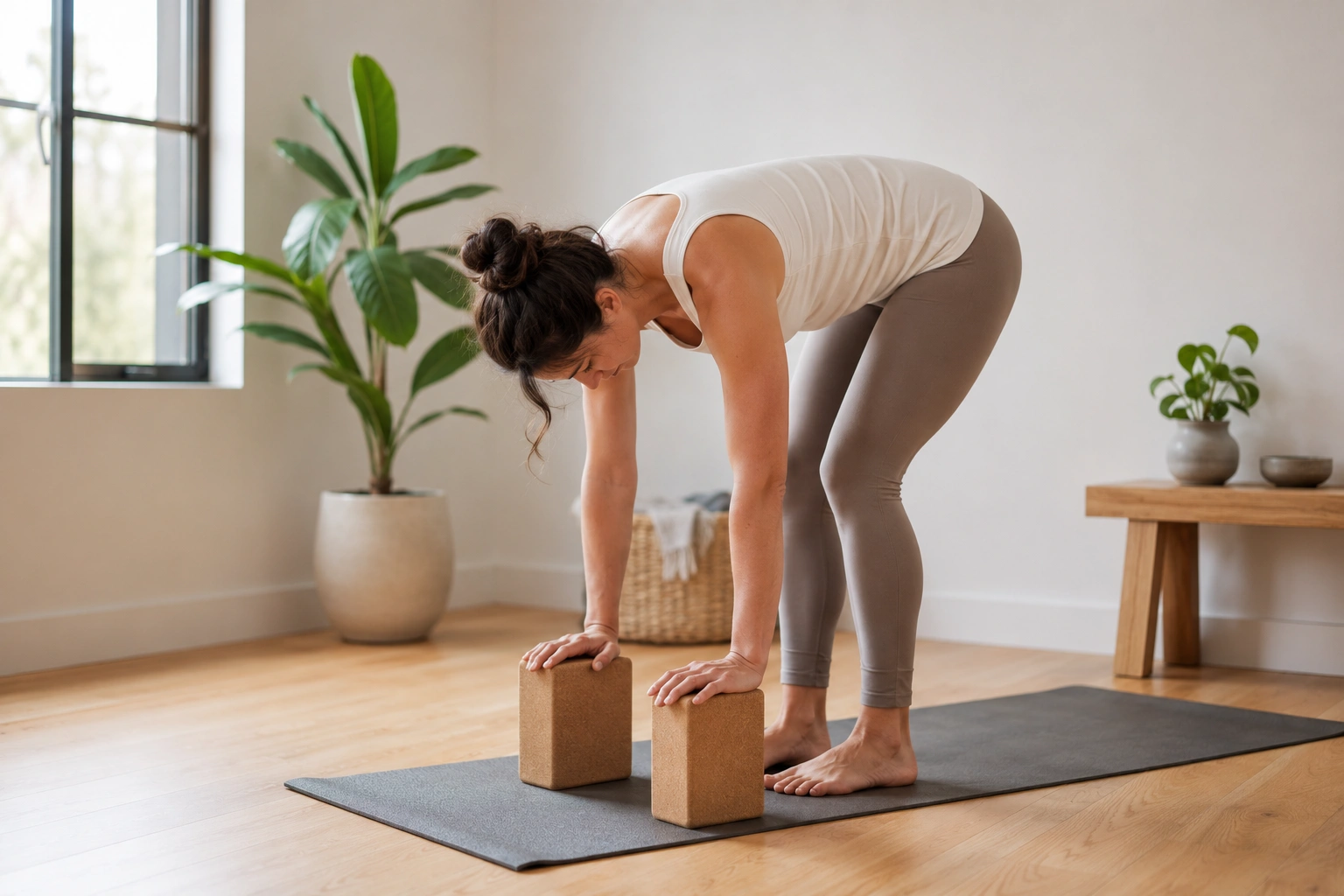
Yoga props for beginners can bring the floor closer, provide feedback, support balance, reduce strain, and help students remain in a position without collapsing or forcing.
Consider a standing forward fold. Without blocks, a beginner may round the back aggressively in an attempt to touch the floor. With hands resting on blocks, that same student may be able to lengthen the spine, bend the knees, breathe more comfortably, and understand the intended movement.
The prop did not make the pose easier in a meaningless way. It made the pose more useful.
4. You Can Tell the Difference Between Effort and Pain
Beginning yoga often introduces unfamiliar sensations. Muscles may work in ways you are not accustomed to. Mild stretching, trembling, warmth, and fatigue can occur during physical activity.
Sharp, electrical, pinching, burning, or escalating pain is different. So is pain that affects a joint or continues after you leave the pose.
Progress means developing enough body awareness to distinguish productive effort from a warning signal. It also means giving yourself permission to stop without turning the decision into a character judgment.
The NCCIH advises beginners to practice under the guidance of a qualified instructor, avoid extreme positions and forceful breathing when inexperienced, and discuss appropriate modifications when medical conditions, injuries, pregnancy, or mobility concerns are present.
Yoga invites attention. It does not require obedience to pain.
5. Your Transitions Become More Controlled
Beginners understandably focus on named poses. Downward-Facing Dog receives attention. Warrior II receives attention. The awkward journey between them is treated like hallway traffic.
But transitions are part of the practice. Lowering a knee gently, stepping forward with control, moving from the floor to standing, and changing direction without rushing all build coordination and awareness.
You may not notice this progress at first. Then one day, you stop crashing into a lunge. You adjust your stance before your knee complains. You move through a sequence without constantly looking around to see what everyone else is doing.
This is functional yoga progress. It can matter far beyond the mat because daily life is full of transitions: standing from a chair, reaching toward the floor, climbing stairs, turning, carrying, and catching yourself when you lose balance.
6. You Recover More Quickly From Distraction
Mindfulness is not the permanent absence of thought. If that were the standard, most yoga classes would end after someone remembered an unanswered email.
The mind wanders. Progress lies in noticing and returning.
You may return attention to the breath, the pressure beneath your feet, the instructor's voice, or the sensation of your hands against the mat. Over time, the return may become less dramatic. You do not have to criticize yourself, restart the entire practice, or declare that you are bad at mindfulness.
This ability to redirect attention is a meaningful form of mindfulness for beginners. The goal is not to become empty-headed. It is to become more aware of where your attention has gone and more deliberate about where you place it next.
7. You Keep Showing Up
Consistency does not mean practicing for an hour every day. It does not require a sunrise routine, matching clothing, or a designated room containing a tasteful amount of bamboo.
Consistency means establishing a version of yoga that can survive your actual life.
That might be ten minutes twice a week. It may be one beginner class every Saturday. It could include chair yoga on a low-energy day, a breathing practice before bed, or three poses after a long commute.
A sustainable beginner yoga routine is more valuable than an ambitious plan that disappears after nine days. The mat does not keep attendance records. You can return without explaining where you have been.
What Yoga Progress Is Not
Yoga progress is not automatically touching the floor with straight legs, performing advanced poses, sweating more than everyone else, buying expensive equipment, losing weight, practicing through pain, being the calmest person in the room, or looking like the teacher.
Some physical milestones may be satisfying, and there is nothing wrong with working toward a challenging pose under appropriate guidance. The problem begins when one visible outcome becomes the entire definition of success.
If you become more flexible but less attentive, more competitive, or more willing to ignore pain, the practice may be moving in the wrong direction.
A Simple Progress Check for Beginners
Instead of testing how close your hands are to your toes, ask yourself a few better questions after practice.
Did I breathe comfortably? Did I notice where I was tense? Did I modify a pose when I needed to? Did I feel stable enough to control my movements? Did I learn something about my body today? Do I feel better, worse, or simply different than when I started?
There is no requirement that every answer be positive. Yoga is not a machine that dispenses calm after a precise number of poses. Some practices feel spacious. Others feel distracted, stiff, emotional, or ordinary.
Awareness of the experience is itself part of the experience.
How to Begin Without Chasing Flexibility
Choose a beginner, gentle, foundational, or slow-flow class rather than selecting a class solely because it promises dramatic results. Tell the instructor that you are new and mention injuries, mobility limitations, or relevant health concerns. Place blocks nearby before class begins so you do not have to decide whether you "deserve" them later.
Keep the knees soft in forward folds. Use a wall for standing balance. Rest when your breathing becomes difficult to control. Skip any pose that produces pain or feels unsafe. Avoid comparing your beginning with another person's tenth year.
Most of all, practice curiosity.
Your body is not an obstacle standing between you and yoga. Your body, exactly as it is today, is where the practice begins.
The Real Goal Is Not the Floor
One day, you may touch your toes. Your hamstrings may become more comfortable, your hips may move more freely, and poses that once felt impossible may become familiar.
That can be gratifying. Celebrate it.
But the more important change may be that you no longer need the pose to prove anything. You can bend your knees, reach for a block, step out of a balance, or take Child's Pose while the rest of the room continues moving.
You begin to understand that yoga is not a performance of how far the body can go. It is a practice of noticing how you go there.
So stop trying to touch your toes as quickly as possible. Learn to feel your feet. Learn to breathe. Learn to recognize effort, resistance, balance, distraction, and rest.
The floor will still be there later.