On the first icy morning of the season, one foot often slides a few inches farther than planned on the walk to the car. Whether that moment ends with a quick recovery or a fall depends on reflexes, ankle strength and the ability to shift weight onto one leg without thinking. All three can be trained at home in the weeks before winter arrives.
A 2019 Cochrane review of 108 randomized trials involving 23,407 people living in the community found that exercise reduces the rate of falls among older adults by 23 percent. The same review found that balance and functional exercises alone cut the rate by 24 percent. A well-built yoga practice consists largely of balance and functional work done slowly. A 20-minute yoga balance workout two or three times a week applies those findings at home with nothing more than a mat and a kitchen counter.
Cold weather adds its own strain, because muscles and joints feel stiffer on a winter morning and heavy boots change how the foot meets the ground. Darker afternoons also make a curb or a patch of ice harder to see on the way home from work or the store. Balance training cannot change the weather, but it can shorten the time the body needs to respond when footing gives way. That is the reason to start before the first freeze rather than after it.
The sequence below is designed for beginners and for anyone over 60, and every part of it is done beside a counter or a sturdy chair.
The Centers for Disease Control and Prevention reports on its older adult falls data page that more than 14 million people, or one in four adults 65 and older, report falling every year. Falls are the leading cause of injury for adults in that age group. The agency also reports that the age-adjusted fall death rate rose 21 percent from 2018 to 2024, from 64.7 to 78.4 per 100,000 older adults.
The Cochrane review, led by Cathie Sherrington of the University of Sydney's Institute for Musculoskeletal Health, gave clinicians their clearest guidance on which kinds of exercise work. Programs combining multiple types of exercise, usually balance work plus strength training, probably reduced the rate of falls by 34 percent, while Tai Chi may have reduced it by 19 percent. The review team also cautioned that "more work is needed to establish the impact of exercise on fall-related fractures" and on falls serious enough to require medical attention.
Yoga has a smaller body of evidence behind it, beginning with a 2016 meta-analysis by Youkhana and colleagues, a team that included Sherrington, published in the British Geriatrics Society's journal Age and Ageing. It pooled six trials with 307 participants aged 60 and older and found a small effect on balance performance and a medium effect on physical mobility. The authors wrote that further research was needed to show whether those gains lead to fewer falls. For that reason, the workout below follows the balance and functional training that the larger Cochrane review supports.
Every pose in this sequence narrows your base of support, shifts your weight or asks you to move while standing, because balance improves only when it is challenged. Throughout the workout, rest your fingertips lightly on the counter instead of gripping it, and lift the hand away only when a pose feels steady for the full count. Hold each pose for five slow breaths unless the instructions say otherwise, and repeat each one-sided pose on both legs.
Work in bare feet or thin, grippy socks on a mat placed against the counter, since thick cushioned shoes dull the signals your feet send to the brain about where the floor is. Sharpening that proprioception is much of what this workout is meant to do. Our guide on proprioception and end-range strength explains why the sense matters even for people who think of themselves as flexible.
Spend the first four minutes in Mountain Pose facing the counter with your feet hip-width apart, slowly rocking your weight forward toward your toes and back toward your heels ten times. Then rock side to side ten times, keeping each movement small enough that your feet never leave the floor. Follow the rocking with twenty slow heel raises, lowering over a count of three each time. The raises load the calf muscles that do most of the work in a stumble.
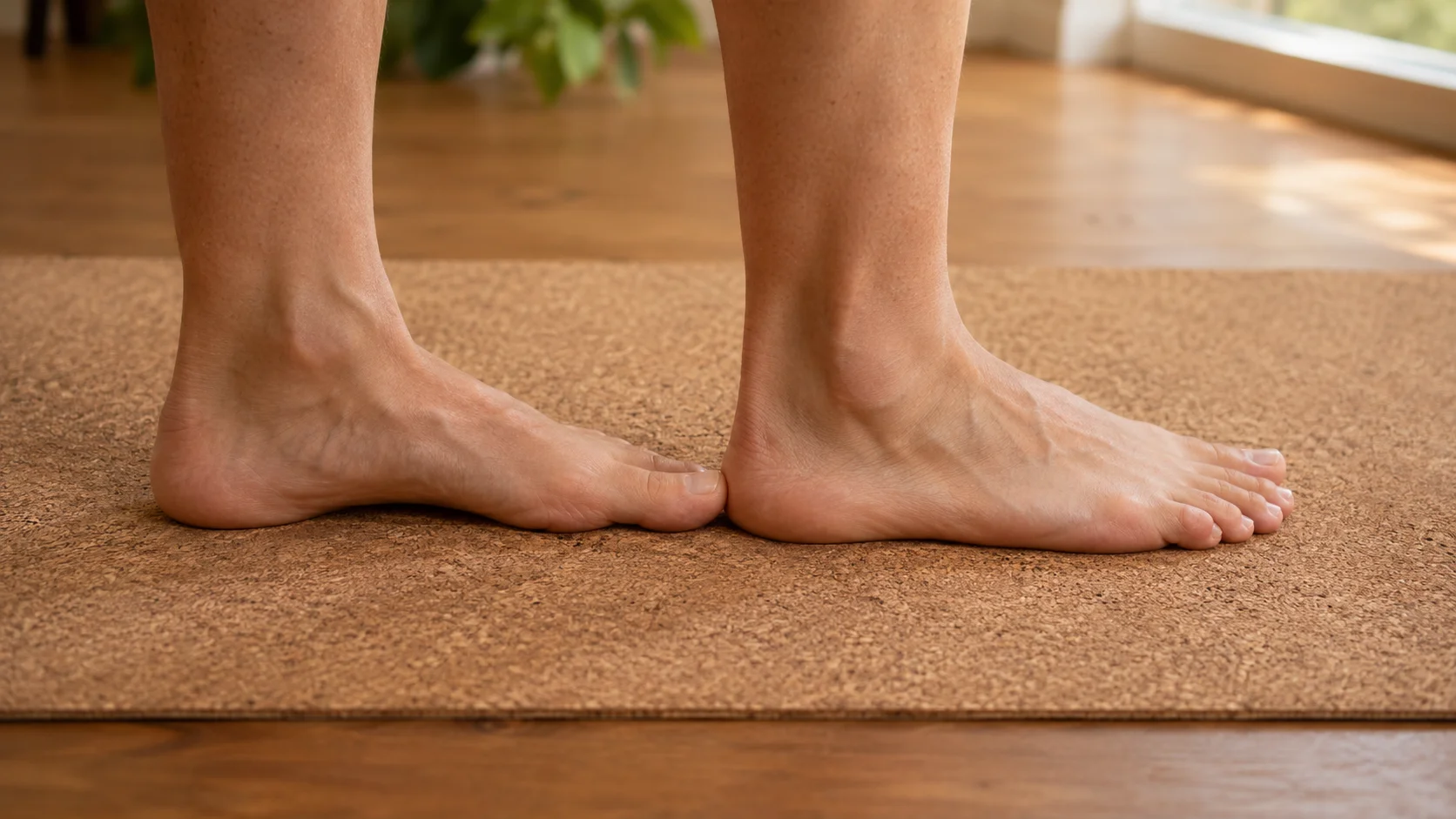
From minute five through minute nine, move into a tandem stance by placing one foot directly in front of the other, heel touching toe, as if standing on a painted line. Hold it for thirty seconds on each side, and once that feels easy, turn your head slowly to look over one shoulder and then the other. Next comes Tree Pose, with the lifted foot resting on the ankle or calf and never on the knee, held for five breaths per side. Keep a soft bend in the standing knee and fix your gaze on one spot on the wall.
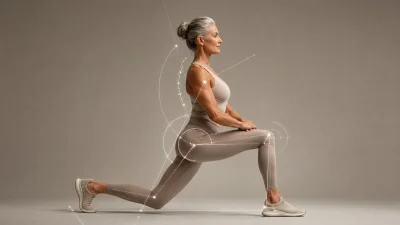
Minutes ten through fifteen build strength on one leg, starting with Warrior III, which trains the hip and ankle muscles that keep you upright after a slip. From standing, hinge forward from the hips with both hands on the counter, extend one leg straight behind you at whatever height you can control, and hold for five breaths before switching sides. Chair Pose follows, with feet together and hips sinking back as if toward a seat, held for five breaths and repeated three times. Finish this block with ten slow step-backs on each side into a short lunge, using the counter for balance and pressing through the front heel to return to standing.
In the last five minutes, walk heel to toe along the counter for ten steps forward and ten steps back. Then stand in Mountain Pose with Eagle Arms and your eyes closed for three breaths, keeping one hand near the counter. Closing the eyes removes your visual reference and makes the inner ear and feet do the balancing, which is the hardest version of the skill and the one an icy driveway tests. Close the session with two minutes seated in a chair, feet flat on the floor, breathing slowly.
After two weeks, increase the challenge by changing one thing at a time, such as resting a single finger on the counter instead of a full hand. Once that feels steady, try the pose with no hand at all, and then with your eyes closed. A folded blanket or a foam pad under the feet adds instability without adding much risk. Our evidence guide to yoga props covers how blocks and bolsters can make standing poses easier or harder.
Balance improves through repetition over several weeks rather than through any single hard session, so showing up three times a week counts for more than pushing through a long workout. Those three sessions, combined with regular walking and some strength training, resemble the combined programs that produced the largest effect in the Cochrane review. Anyone who has fallen in the past year, uses a walker or cane, or experiences dizziness should talk with a doctor or physical therapist before starting. The same goes for anyone managing a condition that affects balance, because a tailored program may be safer.
Put this fall prevention exercise on the calendar as a seasonal habit alongside a flu shot and a fresh set of snow tires, and keep it there through the end of winter. A practice that spends ten minutes of every session on one leg trains the body to recover its footing. By January, a slide on the driveway is more likely to end with a quick step than with a hand grabbing for the car door.