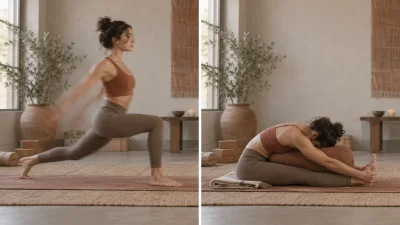
In 2009, researchers at a Sydney pain clinic designed an experiment that allowed each participant to serve as their own control. Thirty adults with at least three months of musculoskeletal pain had one leg randomly assigned to a daily hamstring stretch while the other received no stretching. The intervention lasted one minute a day for three weeks, and the assessor did not know which leg had been assigned to stretch.
The result, published in Physical Therapy, challenges one of the most common assumptions about flexibility. Stretching did not meaningfully increase muscle extensibility. The mean difference in hip flexion between the stretched and unstretched legs was one degree, with a confidence interval from negative two to four degrees. What changed was stretch tolerance, which improved by eight degrees, with a confidence interval of five to ten. The participants had not substantially lengthened their muscles. They had become more comfortable moving farther into the sensation of a stretch.
Cynthia Weppler and Peter Magnusson examined the broader evidence in a review published in the same journal the following year. They concluded that increases in muscle extensibility observed after a single stretching session and after short-term programs lasting three to eight weeks are largely due to modified sensation. Muscle and connective tissue do change length temporarily during a stretch because of their viscoelastic properties, but those changes do not necessarily persist.
That distinction changes the way yoga props should be understood. A block, strap or bolster is not necessarily helping the body become permanently longer. Its more practical function is to alter position, load and duration so a person can remain in a posture with greater control.
A Prop Does Not Eliminate the Work. It Changes Where the Work Happens.
One common criticism of supported yoga is that modifying a posture makes it physically easier and therefore less useful. A 2025 study in the International Journal of Yoga directly compared muscle activation in standing and seated versions of yoga poses. Researchers placed surface electrodes on the biceps femoris, rectus femoris, external obliques and erector spinae of twenty-six healthy adults, then had participants hold eight poses for ten seconds each in randomized standing and seated-equivalent conditions.
As expected, leg activation was higher during the standing versions. Core activation, however, was higher in the seated conditions. In Goddess pose, the seated version produced significantly greater activation in the left external oblique and left erector spinae than the standing version, with p below .05. The modification did not simply remove muscular demand. It redistributed it.
Research on older adults provides another measure of how demanding yoga postures can be. The Yoga Empowers Seniors Study examined twenty ambulatory adults with an average age just under seventy-one in a motion laboratory. Crescent, Chair, Warrior II and One-legged Balance produced mean support moments of 1.09 newton metres per kilogram, which the researchers noted was 42 percent greater than walking. The trailing-limb knee adductor moment during Warrior II reached 267 percent of the peak measured during walking.
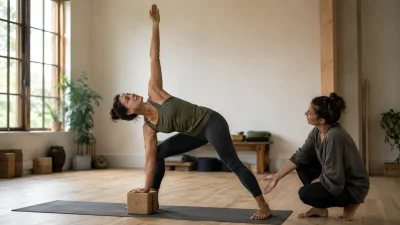
The study's methods also illustrate how props function in practice. Participants used foam blocks during One-legged Balance, chairs during Side Stretch and Crescent, and a plexiglas wall during Wall Plank. The researchers were measuring the physical demands of yoga in older adults, yet modifications were still part of the protocol. Props were not treated as a retreat from the posture. They were part of the means by which participants performed it.
The Case for Longer, Lower-Load Holds
A separate line of research helps explain the mechanical value of bolsters and other forms of support. Work dating to a 1984 trial comparing low-load prolonged stretching with high-load brief stretching in knee contractures favored the prolonged, lighter approach. A 2011 review in Sports Health summarized the principle by stating that the goal of a stretching protocol is to maximize total end-range time. The review noted benefits from ten- to fifteen-minute bouts repeated several times a day for certain hypomobility conditions.
That is where a bolster becomes mechanically useful. An unsupported forward fold held for ten minutes would be unrealistic for many practitioners because muscular effort, discomfort or balance would end the posture first. Support can reduce those constraints and make a longer hold possible. Marla Apt, a senior Iyengar teacher who studied in Pune, describes the function in similarly practical terms.
"Props enable the student to hold the pose for a much longer duration than when performed independently."
What Restorative Yoga Trials Actually Show
The strongest evidence does not uniformly favor restorative yoga, and the comparison matters. The PRYSMS trial randomized 180 underactive adults with metabolic syndrome to either restorative yoga or stretching across 48 weeks at University of California campuses in San Francisco and San Diego. Of those participants, 135 completed the study.
At twelve months, fasting glucose declined more in the restorative yoga group, by negative 0.35 millimoles per litre compared with negative 0.03 in the stretching group, with p equal to 0.002. The researchers found no other statistically significant differences between the groups.
A companion paper in Psychoneuroendocrinology produced results that favored stretching on some stress measures. At six months, the stretching group showed decreases in waking and bedtime cortisol relative to the restorative yoga group. At one year, perceived stress had fallen by two points more in the stretching group, with p equal to 0.04. The authors suggested that the greater social interaction and group support built into the stretching classes may have contributed to the difference.
A broader positive signal comes from a 2019 meta-analysis in Mayo Clinic Proceedings covering 49 yoga studies published between 1983 and 2018. Yoga programs that emphasized both breathing and mental relaxation, characteristics common to restorative practice, were associated with blood pressure reductions of 11 over 6 millimetres of mercury. Programs without that emphasis produced reductions of 6 over 3. Lead author Yin Wu summarized the difference in the university's report on the findings.
"We found that among individuals with hypertension, yoga practice that emphasized both mental relaxation and breathing techniques can result in blood pressure reductions as large as 11/6 mmHg, which is equal to or exceeds those reported for aerobic exercise training."
The Injury-Prevention Claim Has Not Been Directly Tested
Yoga props are frequently recommended as a way to prevent injury, but the available injury literature does not establish that using a block, strap or bolster reduces injury risk.
Researchers have documented where yoga injuries occur and how frequently they are reported. An analysis of United States emergency department records identified 29,590 yoga-related injuries between 2001 and 2014. The injury rate per 100,000 participants increased from 9.55 to 17.01 during that period. In 2014, the rate was 11.90 among adults ages eighteen to forty-four, 17.7 among those ages forty-five to sixty-four and 57.9 among adults sixty-five and older.
A systematic review involving 7,453 participants estimated an overall rate of 1.18 injuries per 1,000 yoga hours, with lower-extremity injuries accounting for 64 percent.
The largest practitioner survey in this group of studies included 2,620 respondents and was published in the Journal of Bodywork and Movement Therapies in 2019. Forty-five percent of respondents reported never having experienced a yoga injury. Among those who had been injured, four regions accounted for 80 percent of severe injuries: knees at 21.0 percent, lower back at 19.4 percent, shoulders at 19.0 percent and hips or hamstrings at 15.9 percent. The strongest predictors of reporting an injury were years of yoga practice, with p below .0001, and teaching yoga, with p equal to .0177.
The same paper mentions props only as a limitation, noting that yoga styles differ in whether poses are taught with props or hands-on assistance. It does not analyze injury rates according to prop use. The studies cited here do not establish whether using props changes injury risk, nor do they provide experimentally measured changes in joint angles or loading at different block heights. Specific numerical claims about how many degrees a four-inch block changes hip flexion should therefore be treated cautiously unless they are supported by separate biomechanical research.
Choosing the Three Props That Matter Most
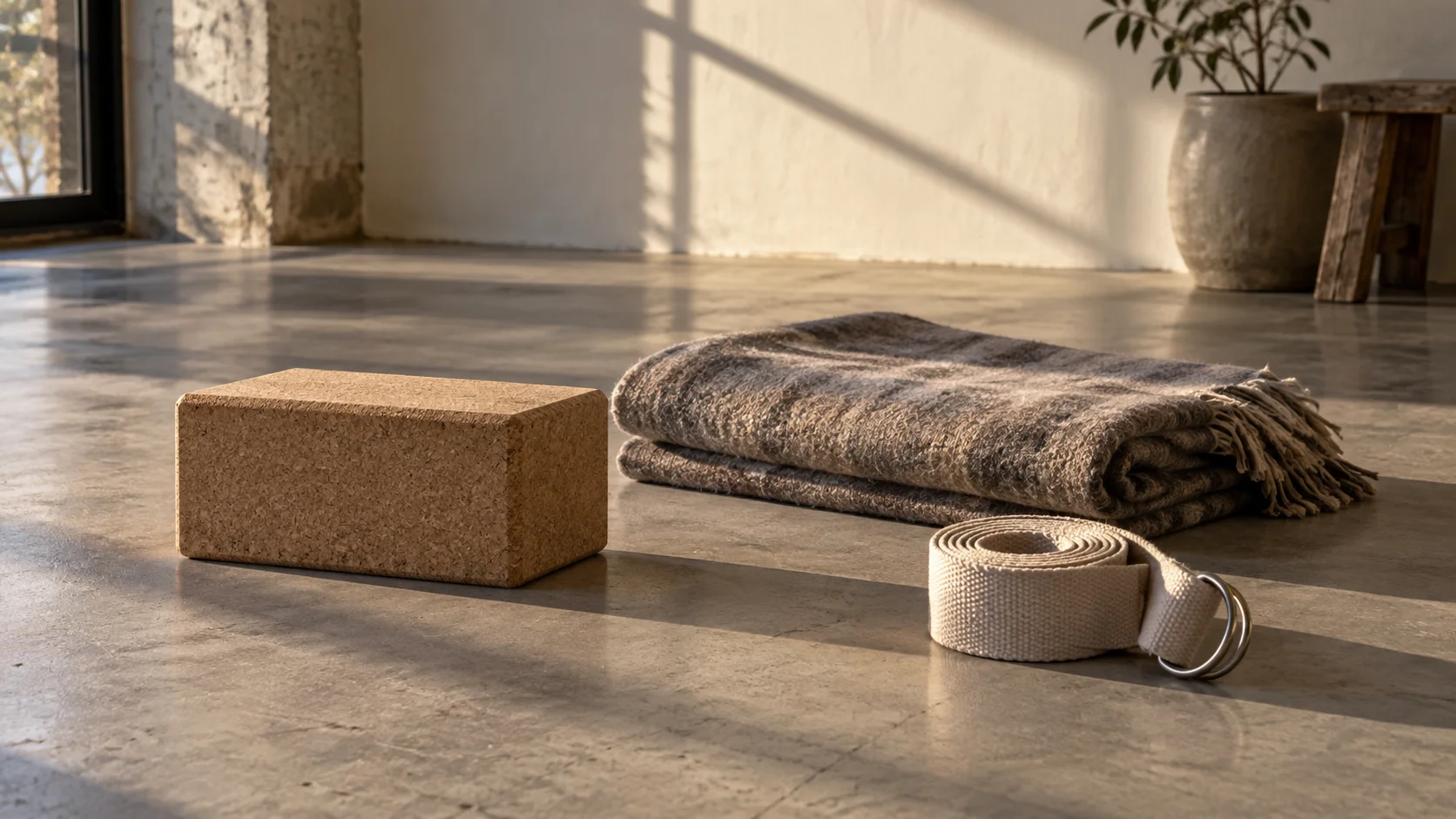
For yoga blocks, dimensions determine how many usable levels of support a practitioner has. Hugger Mugger offers a smaller block measuring 3 by 6 by 9 inches, a studio-standard version measuring 4 by 6 by 9 inches and a larger model measuring 5 by 12 by 6.75 inches. Because a rectangular block can rest on three different faces, each model effectively provides three support heights.
Material changes the experience as much as size. Manduka sells cork and recycled foam blocks for $26 each, both measuring 9 by 6 by 4 inches. The cork weighs 2.2 pounds, compared with one pound for the foam version. The heavier cork construction offers a firmer base when substantial pressure is placed through the hand, while foam is considerably easier to carry. Gaiam lists a cork block at $19.98 and an Essentials foam block beginning at $12.99, making blocks the least expensive of the major support props.
Bolsters require a larger investment, and their dimensions affect positioning. Hugger Mugger's standard bolster costs $114 and measures 11 by 25 by 6 inches at a weight of five pounds. Canadian manufacturer b, halfmoon offers a cylindrical bolster at $118 measuring 8 by 8 by 24 inches and a rectangular model at $112 measuring 5 by 10 by 24 inches. Although the two are similar in length, their shapes and heights create different levels of elevation beneath the torso during supported folds and backbends.
A strap is simpler but often more versatile. Manduka's Align strap is 1.75 inches wide, made from unbleached cotton and fitted with a zinc-alloy buckle. It costs $20 for six feet and $24 for ten. Gaiam sells an eight-foot strap for $9.98. The longer version offers more usable length for wrapped positions and configurations beyond a basic supine hamstring stretch.
Yoga Props Have a Much Longer History Than the Modern Studio
B.K.S. Iyengar's Light on Yoga, first published in 1966, described a system that made extensive use of belts, bricks and ropes. The broader idea of supporting the body during practice is considerably older. A cloth strap known as a yogapatta was used to support seated postures roughly two thousand years ago. It appears in carvings at the Great Stupa of Sanchi, dated to approximately 50 BCE to 50 CE, as well as in seventh-century sculpture at Mamallapuram and Ellora.
Dean Lerner, a certified advanced Iyengar instructor, described the appropriate role of props in Yoga Journal by emphasizing that they are aids for particular circumstances rather than an objective of practice in themselves. That distinction is consistent with the research. A prop can alter position, distribute muscular demand and make longer holds possible, but it should not be credited with physiological effects that have not been demonstrated.
The stretch-tolerance research is especially useful because it changes the definition of progress. Greater range of motion after weeks of stretching may reflect an increased ability to tolerate the sensation at end range rather than a permanently lengthened muscle. Readers examining the same question from another direction can find it in our reporting on what end-range strength means for hypermobile students and what progress looks like when flexibility is not the measure.
For someone building a home practice, that leaves a practical hierarchy. Blocks provide inexpensive, adjustable height. Bolsters make prolonged supported positions more feasible. Straps extend reach without forcing additional range. Of the three, a strap is the simplest place to start and usually costs less than a single yoga class.