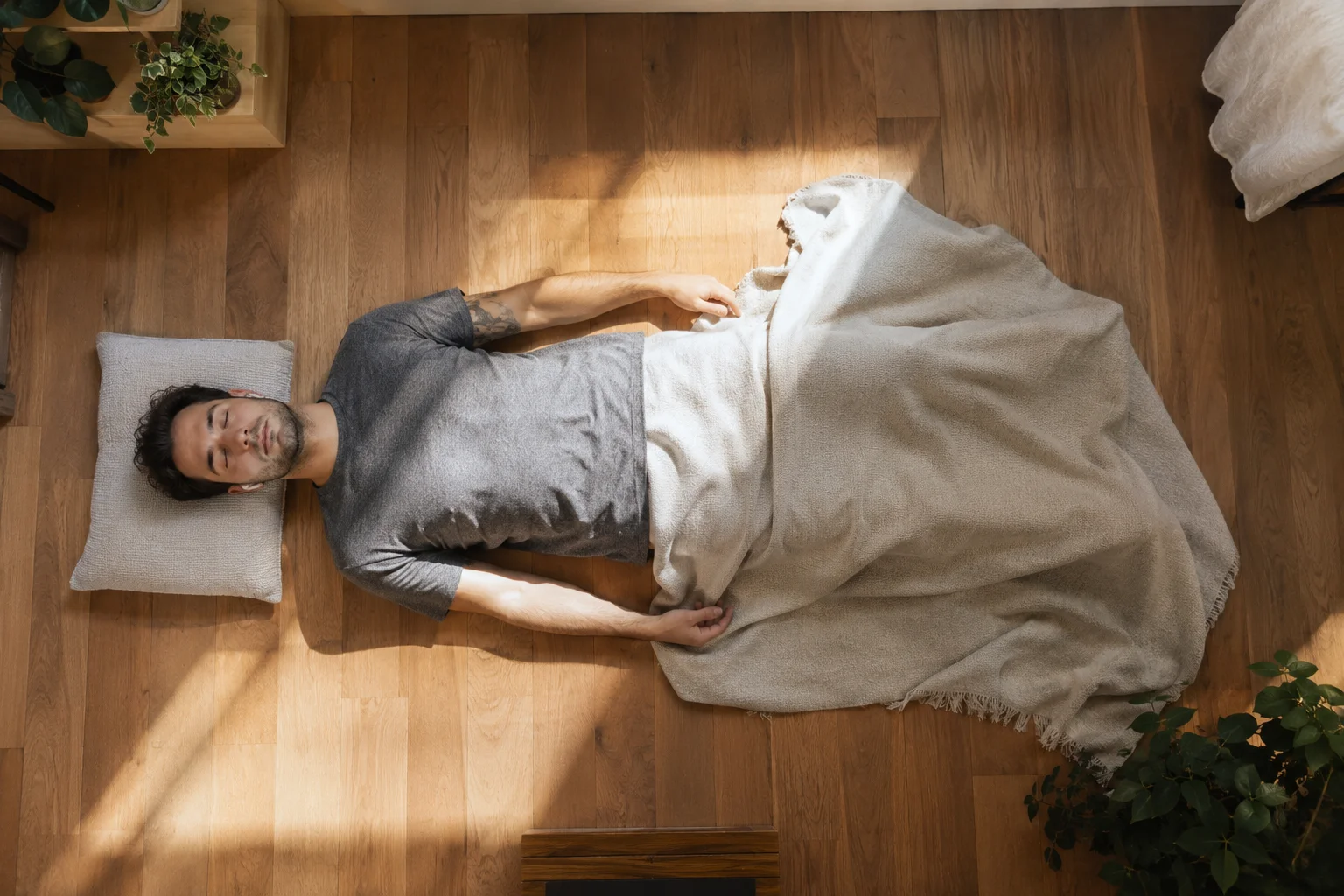
Lie down on the floor in the flat middle of the afternoon, close your eyes, and let a recorded voice walk you through your body, toe by toe, rib by rib. You are not asleep. You are not sitting cross-legged in a cloud of incense either. You are doing something the internet has decided to rebrand, and there is a decent chance the person next to you on the train is doing it too, earbuds in, eyes shut, ten minutes reclaimed from a Tuesday.
The practice underneath the hype is old. Yoga nidra, often translated as yogic sleep, is a reclining form of guided relaxation in which a teacher leads you through a slow inventory of the body, some breath awareness, and often a quiet intention. You stay on the threshold of sleep without crossing it. What is new is the paperwork. In 2026, the research on this deep rest practice got a lot bigger, and the findings are worth reading with your eyes open.
So does it work? The short answer is yes, modestly, and mostly for sleep and stress. The larger caveat is that the evidence is real but softer than a wellness feed will admit, and the best studies keep saying the same thing about the rest of the studies.
What is yoga nidra?
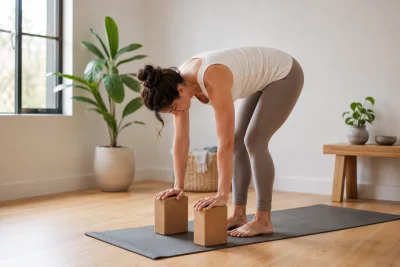
Strip away the mysticism and the format is simple. You lie down, usually on your back, and follow a recorded or in-person script. Most sessions lean on a guided body scan, moving attention systematically from the feet upward, which gives the busy mind a small, boring job to do. Some versions add breath counting or a sankalpa, a short personal resolve. Sessions run anywhere from eight minutes to forty. Unlike a vinyasa class, nothing here asks your hamstrings for anything. This is the opposite of your 15-minute morning flow, a sequence built to wake the body rather than power it down.
The point is downshifting. Teachers talk about moving out of fight or flight, and the more clinical framing is nervous system regulation, the slow tilt from sympathetic arousal toward the parasympathetic state where digestion, repair, and rest take place. That shift is also the through line of the somatic yoga movement, which trades performance for interoception, the skill of feeling what is going on inside.
The 2026 evidence, without the hype
Two large reviews landed within months of each other, and together they are the reason this practice is having a moment beyond the algorithm.
Sleep
A systematic review in the Journal of Integrative and Complementary Medicine pulled together six randomized controlled trials covering 244 people, from chronic insomnia patients to hypertensive adults to healthcare workers who lived through COVID wards. Across them, participants fell asleep faster and stayed asleep longer. The measurable win was sleep onset latency, the stretch of time between lights-out and actually drifting off, along with total sleep time and efficiency. If your complaint is that you lie in bed narrating your own worries, that is the exact gap this addresses. The gains in sleep quality were consistent enough to matter. The authors were also blunt about the limits, concluding that "high-quality, methodologically robust RCTs are needed to confirm its efficacy."
Stress and mood
The bigger number came from a meta-analysis in the Annals of the New York Academy of Sciences, led by Shashank Ghai, which swept up 73 trials and 5,201 participants. The effect sizes for stress and anxiety were large on paper, with reductions in anxiety landing around a Hedges' g of 1.35 against active comparisons. Depression scores moved less but still moved. Then the same authors pumped the brakes, warning that given the uneven quality of the underlying trials, the numbers "should be interpreted cautiously" and probably overstate the real effect. Their recommendation is that yoga nidra works best as an add-on, not a stand-in for treatment. The effect size and the caveat belong together.
Why cortisol keeps coming up
The most precise recent study is smaller. Researchers at the University of the Bundeswehr Munich, led by Esther Moszeik, ran 362 German-speaking adults through daily sessions of either 11 or 30 minutes and tracked their cortisol rhythms through saliva samples, work reported this past year. Cortisol is supposed to spike in the morning and taper across the day. Chronic stress smears that curve flat or keeps it elevated at night. The 30-minute practice reshaped the morning response, and even the short version lowered total daily output with consistent use. "Even the brief 11-minute meditation produced noticeable benefits," the team noted, a finding that quietly undercuts the assumption that longer is always better.
Hormones are not the whole story, and one biomarker does not prove a practice. But it is a mechanism you can point to, which is more than a lot of wellness trends can offer. Even in hip-hop the vocabulary of cortisol and calm has crept in, as when HitsCulture unpacked Gunna's stress relievers around his single "Got Damn."
NSDR, Huberman, and the branding of rest
If you found this practice through a podcast rather than a yoga studio, you probably met it as non-sleep deep rest. The term was coined by the Stanford neuroscientist Andrew Huberman as an umbrella label for guided relaxation that skips the loaded word meditation. Yoga nidra is a subset of it. The rebrand is not cynical so much as strategic, a way to get people who would never book a yoga class to lie down and try. Huberman describes the payoff plainly, saying it "quiets the mental chatter and anxious thoughts" that block sleep.
The naming matters for one practical reason. When you search, NSDR and yoga nidra will surface slightly different recordings. The NSDR clips tend to be shorter and more secular. The yoga nidra tracks are often longer and carry the older yogic language of koshas and intention. Neither is more correct. Pick the voice you will actually return to.
How to try it without overthinking
Start with something short and free. Ten to fifteen minutes, lying down, somewhere you will not be interrupted, ideally with a blanket because body temperature drops as you settle. Afternoon slumps and the hour before bed are the two highest-yield windows. Do not chase sleep during the daytime sessions, and do not judge the practice by whether your mind went quiet, because a wandering mind that keeps getting gently returned to the body is the practice working, not failing.
Consistency beats duration, which is the clearest practical lesson from the cortisol data. A daily 11-minute habit outperformed the occasional long session. Treat it like brushing your teeth, a small daily piece of maintenance rather than an event.
The larger point is worth holding lightly. Yoga nidra is not a cure, and the researchers studying it are the first to say so. It is a low-cost, low-risk tool that helps a lot of people fall asleep faster and feel less frayed, backed by 2026 evidence that is both encouraging and incomplete. That is a rare and useful place for a wellness trend to sit. Lie down, press play, and let the floor hold you for ten minutes. Your nervous system has been waiting for the invitation.