By late afternoon, a person who has spent eight hours at a laptop and another hour scrolling on the train home tends to carry the day in the same place, a dull ache at the base of the skull that creeps across the tops of the shoulders and makes turning to check a blind spot feel like a negotiation. Neck pain ranks among the most common musculoskeletal complaints adults bring to a doctor, and it has become a familiar side effect of working, reading and relaxing with the head tipped toward a screen.
Yoga is one of the better-studied responses to that ache, and the evidence for it is more encouraging than most people expect, though it comes with limits that a beginner should understand before rolling out a mat. Two systematic reviews published in 2017 and 2019 pooled the randomized trials on yoga for chronic neck pain, and both found meaningful short-term improvements in pain and in the everyday disability that neck pain causes.
The first, led by Holger Cramer at the University of Duisburg-Essen and published in Clinical Rehabilitation in 2017, combined three trials with 188 patients that compared yoga with usual care. The authors concluded that "yoga has short-term effects on chronic neck pain, its related disability, quality of life, and mood," and wrote that their findings suggested "yoga might be a good treatment option" for people living with the condition.
The second review, by Yunxia Li and colleagues in the journal Medicine in 2019, was larger, pooling 10 trials with 686 participants. It found that yoga reduced neck pain intensity and pain-related disability, improved how far participants could turn and tilt the head, and lifted quality of life and mood, and the National Center for Complementary and Integrative Health cites a 2019 review of 10 studies reaching the same conclusion on its consumer guide to yoga.
The size of those effects is worth noting, because the pooled improvement in pain intensity in the 2019 review was large by the conventions researchers use to grade such results. The authors still called their conclusions "very cautious," pointing to the wide variety of yoga styles, session lengths and measurement tools across the trials, and Cramer's team described its findings as short-term effects, which is an honest way of saying nobody yet knows how long the benefit lasts after people stop practicing.
That caution shapes how a beginner should approach the practice, since the evidence supports regular, moderate yoga as one part of managing neck pain rather than a single class as a cure. The trials in these reviews typically ran for several weeks with repeated sessions, and the benefits the researchers measured came from that kind of repeated practice over weeks rather than from any single session on the mat.
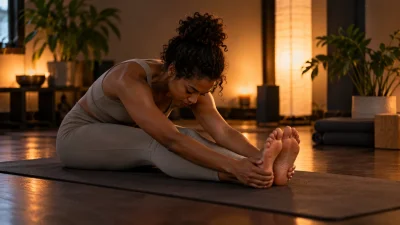
The first principle of a neck-friendly practice is that the neck itself rarely needs to be stretched hard, because the stiffness people feel there often reflects how the upper back, shoulders and chest have been held all day. Poses that open the chest and mobilize the upper back tend to do more for a sore neck than aggressive head rolls, and they carry far less risk of aggravating an irritated joint.
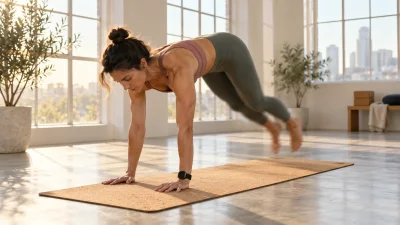
Cat and cow, practiced slowly on hands and knees, is a useful starting point because it moves the whole spine through flexion and extension while letting the head follow the movement rather than lead it. A beginner can let the gaze drift down toward the navel on the exhale and forward toward the front of the mat on the inhale, keeping the motion small enough that the neck never reaches the end of its range.
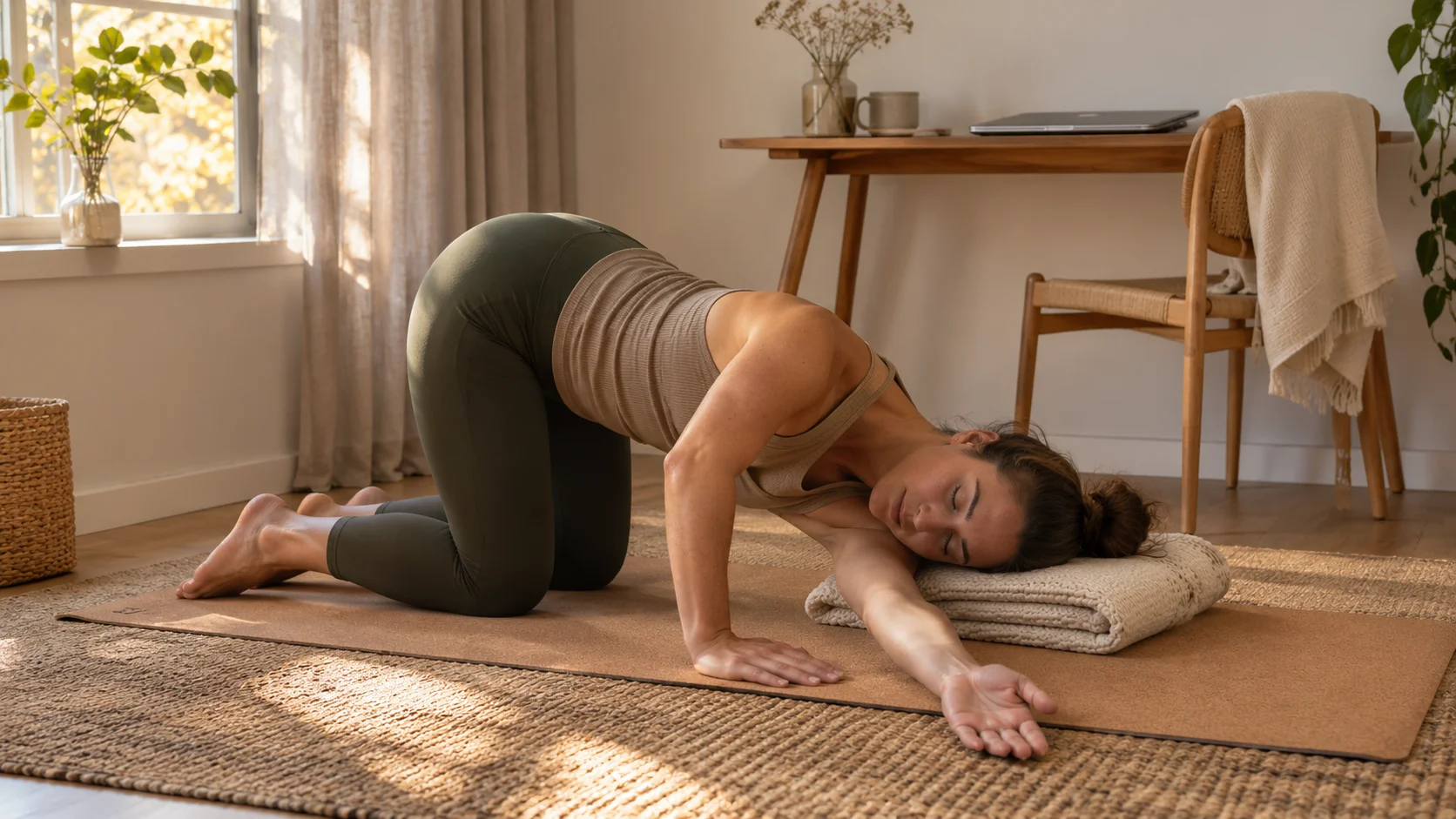
Thread the needle, in which one arm slides under the chest from all fours and the shoulder and side of the head rest on the mat, opens the space between the shoulder blades where many desk workers feel the tightest. A folded blanket under the head keeps the neck in line with the spine, and the Kits n Co. guide to blocks, bolsters and straps explains how a prop like that one lets a beginner hold a pose long enough for it to help.
Eagle arms, which can be done seated at a desk, wrap one arm under the other and lift the elbows to shoulder height, drawing the shoulder blades apart and stretching the muscles across the upper back. Held for five or six slow breaths on each side, it is one of the few yoga shapes that fits naturally into a workday, and it requires nothing more than a chair and a minute between meetings.
A gentle side stretch for the neck belongs at the end of a session rather than the beginning, once the upper back and shoulders have warmed up. Sitting tall, a practitioner can let one ear drift toward the shoulder on the same side while the opposite hand reaches toward the floor, stopping at the first sense of stretch and holding there for several breaths rather than pulling the head with a hand.
The poses to avoid matter as much as the ones to try, and the National Center for Complementary and Integrative Health is direct about them. Its guide advises beginners to "avoid extreme practices such as headstands, shoulder stands, the lotus position, and forceful breathing," and the first two of those load the cervical spine in ways that a person with existing neck pain has no reason to risk while learning.
Plow pose belongs in the same category for anyone with a sore neck, since it pushes the head and neck into deep flexion under the weight of the legs and lower body. Many studios include it near the end of a vinyasa sequence, so a student who is new to a class can quietly substitute a reclined twist or simply rest on the back, which no good teacher will question.
Breathing deserves attention in a neck-focused practice for reasons that have little to do with flexibility. People who are stressed or rushed often breathe high in the chest, recruiting the small muscles along the sides of the neck with every inhale, and a few minutes of slow breathing into the belly and the lower ribs can let those muscles rest after a long day of shallow breaths.
Kits n Co. reported on November 18 on similar findings for yoga and chronic low back pain, where the evidence base is larger and clinical guidelines already list yoga among recommended options. Neck pain has not reached that stage yet, and the smaller number of trials means the advice here should be read as promising rather than settled, especially for anyone whose pain is severe or getting worse.
Some symptoms call for a clinician before a yoga class, including neck pain that follows a fall or a car accident, pain that travels down an arm, numbness or weakness in the hands, and pain accompanied by fever or unexplained weight loss. The NCCIH guide adds a warning that applies to every reader here: "Don't use yoga to postpone seeing a health care provider about a medical problem."
For most people with ordinary desk-related neck pain, a reasonable starting plan is 15 to 20 minutes of gentle practice three or four times a week, built around the chest-opening and upper-back poses described here, with the neck stretch saved for the end. Choosing a teacher matters too, because a hatha or Iyengar class that moves slowly and uses props will usually serve a sore neck better than a heated, fast-paced flow. Age is part of that choice as well, since the NCCIH guide notes that the rate of yoga-related injuries treated in emergency departments is higher in people 65 and older, which makes a slower class with an attentive teacher the better first step for an older student with a stiff neck.