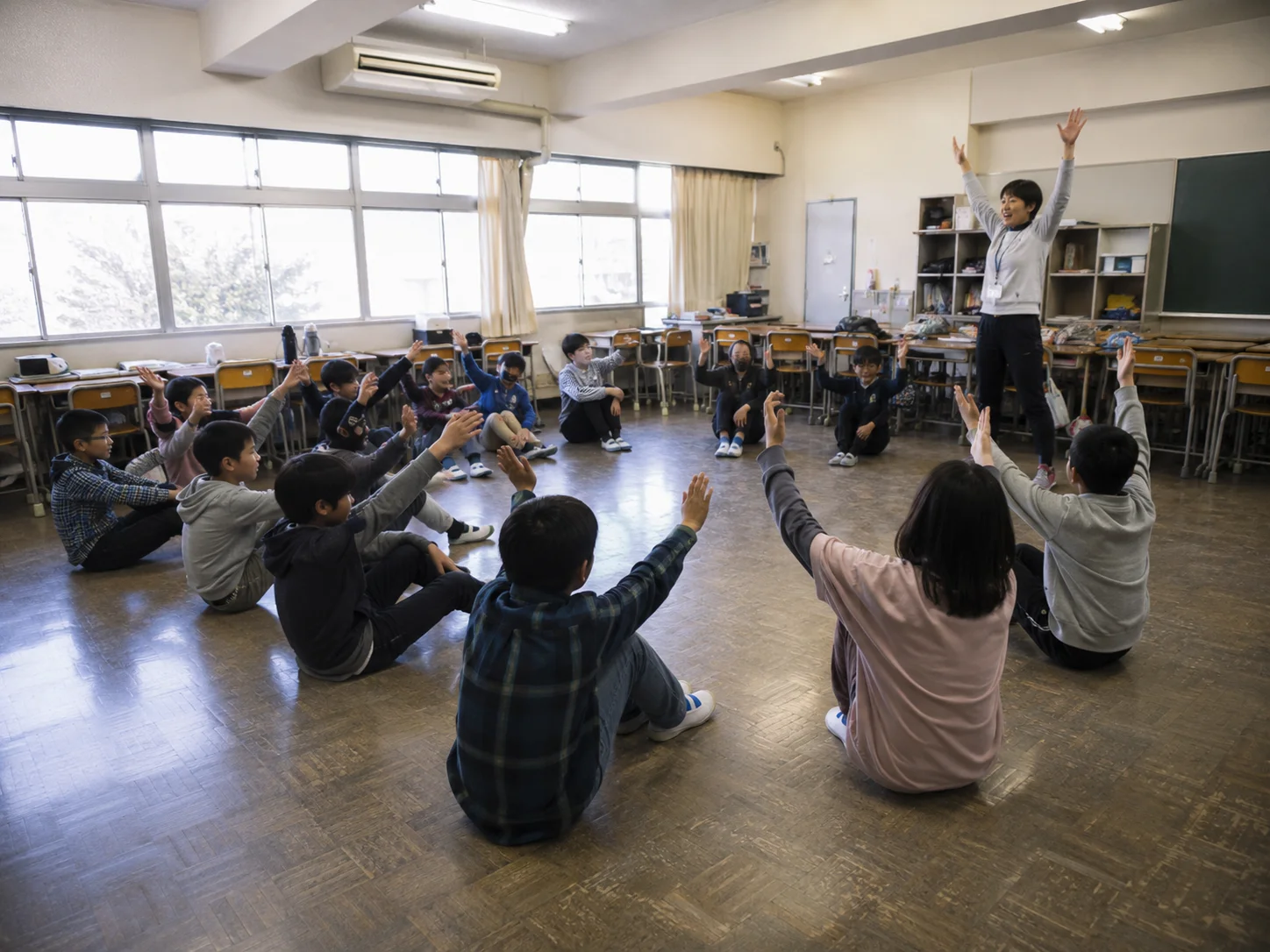
The dose was fifteen minutes. Once a week. Not daily, not thirty minutes, not a semester-long curriculum with a certified instructor and a dedicated room. Fifteen minutes, one morning a week, from September to February, in seven ordinary public elementary schools in Kitakyushu City, Japan.
Four hundred and one children did it. And at the end, their self-esteem and gratitude scores had moved.
Not dramatically. This is where most coverage of yoga research gets sloppy, so here are the actual numbers: the effect size for self-esteem was 0.14, and for gratitude 0.22. In plain terms, those are small. The study also had no control group, which means we cannot rule out that some of the change came from the children simply being five months older. The authors say so themselves, in the paper, without hedging.
The program was called Asa yoga (morning yoga), and it combined asana, breathwork, and loving-kindness meditation into a quarter of an hour. The research team, led by Shoichi Shiota at Aomori University of Health and Welfare with colleagues from a Kitakyushu elementary school and the city's Board of Education, published it in Frontiers in Psychology in July.
"Participation in a brief, structured school-based yoga program was associated with positive pre-post changes."
That is a deliberately unexciting sentence, and it is the right one. But sit with the ratio. Fifteen minutes a week is roughly one hour a month. Most adult practitioners spend more time than that choosing a class. If a small dose of yoga at that scale registers at all in a group of ten-year-olds, the interesting question is not whether we should be doing more. It is why almost nobody is doing this much.
On August 6, a team from the University of Edinburgh published a qualitative study in Psychology of Sport and Exercise asking a different question: what stops school-based yoga programs from happening in the first place. The researchers, working within the university's physical activity and health group, interviewed twenty-three people who would have to make it work. Teachers. Yoga instructors. Secondary school pupils themselves.
The barriers they identified will be familiar to anyone who has ever tried to start a practice inside an institution. Teachers reported limited training and limited confidence in delivering yoga. Space was inadequate. Time was short. And among pupils, yoga carried a perception problem, read as feminine, or simply as unfamiliar, which for a fourteen-year-old is often the more fatal of the two.
So the picture that emerges from these two papers together is not a mystery. It is a supply problem. The intervention works a little, costs almost nothing in minutes, and cannot be delivered because the person standing in the room does not feel qualified to lead it and the room is the wrong shape.
That last barrier, the unfamiliarity, is the one that closes fastest. It closes the same way it closes for adults, which is by lowering the entry price until the thing stops looking like a performance. We have made this argument before for grown beginners in our guide for people convinced they cannot do yoga, and it holds for a school gymnasium too. The yoga teacher training gap in schools is real, but the fix is not a nationwide certification program. It is a fifteen-minute sequence simple enough that a classroom teacher can run it without pretending to be an instructor.
In July, Frontiers in Public Health published a preliminary quasi-experimental study out of Ho Chi Minh City. The researcher, Tra Thi Thanh Kieu of the Department of Psychology at HCMC University of Education, ran a five-day chair yoga for stress program for Vietnamese high school teachers. Forty-five-minute sessions, after work hours, in chairs, because that is what fits in a school building. Sixty-three teachers enrolled, forty-one were analyzable.
"A brief chair yoga intervention appears feasible and acceptable in a Vietnamese high school."
Immediately after the five days, distress scores on the DASS-10 fell from 6.93 to 4.39, an effect size of 0.779. That is a real, moderate-to-large shift from one working week of chair-based practice.
The three-month follow-up is where it gets uncomfortable. Teachers who kept practicing once or twice a week scored 1.38. Teachers who stopped scored 10.60.
Read that again. The teachers who quit did not drift back to where they started. They landed worse than their own baseline.
We want to be careful here, because this is precisely the kind of number that gets turned into a threat by wellness marketing. Forty-one participants is small. There was no control group tracking teachers who never practiced at all. The three-month window covered a stretch of the school year, and school years get worse before they get better. A group of teachers in November is not the same group of teachers in September, regardless of what they did with their afternoons.
The most defensible reading is not that stopping yoga harms you. It is that a five-day intervention did not change anything structural about those teachers' jobs, and when the practice went away, the job was still there, plus three more months of it.
Which is a more honest lesson than the scary one, and a more useful lesson for anyone building a practice. The short course did what short courses do. It gave people a tool and then ended. Consistent yoga practice at once or twice a week is not a bonus round on top of the intervention. In that dataset, it is the only version that held.
Three studies, three countries, one shape. The dose that shows up in the data is small, the frequency matters more than the length, and the failure point is always delivery rather than efficacy.
If you have been telling yourself you will restart when you can commit to an hour, these papers are permission to stop waiting. Fifteen minutes registered in children. Forty-five minutes, five times, moved adult distress scores meaningfully. Nobody in this body of research was doing ninety minutes of vinyasa. Our own fifteen-minute morning flow exists for exactly this reason, and it now has a slightly better evidence base behind it than it did in July.
Second, take the small effect sizes seriously in both directions. A 0.14 on self-esteem is not a transformation and should not be sold as one. It is also not nothing, particularly for an intervention that costs a school fifteen minutes and no equipment. The useful frame is the one our colleagues at Natural Active Care apply to supplements, that feeling fine is the floor and not the ceiling. Small, cheap, repeatable interventions are how floors get raised.
Third, if you teach, note who was studied in the Vietnam paper. Not the students. The teachers. The adults running the room were the ones whose distress scores were high enough to move. That is a familiar story in this industry, and one we have written about at length in the context of what the people teaching you to relax are carrying.
The gap that is left
The evidence for yoga for children in schools is not overwhelming and nobody serious is claiming it is. What the 2026 papers establish is narrower and more actionable: at doses small enough to fit inside a normal school week, something measurable happens, and the reason it is not happening more has almost nothing to do with the yoga.
It is a room. It is a timetable. It is a teacher who has never been shown a sequence and does not want to get it wrong in front of thirty teenagers. Those are solvable problems, and they are cheaper to solve than the ones we usually argue about. Classroom mindfulness programs tend to arrive as curricula, with binders. The Kitakyushu version arrived as a quarter of an hour on a Tuesday morning.
Whatever you take from this, take the frequency. Building a sustainable practice is not a matter of finding the perfect length. It is a matter of finding a length short enough that it survives a bad week, and then not stopping.