Almost every yoga study ever run asks the same soft question: is yoga better than nothing? A paper published this month asked a harder one. Four practices, one outcome, same statistical ring.
The outcome was sleep. The subjects were older adults. And yoga did not win.
The study is a network meta-analysis in The Gerontologist, published August 8, 2026 (DOI 10.1093/geront/gnag186) by Haoyu Yang, Zhongli Wang, Fanghua Wang, Jianbang Su, Zhilin Gu, Yingying Liao, Xiaoyu Liang and Zhenhua Xu. The team screened 3,792 studies, kept 45 randomized trials covering 3,568 participants, and ran a Bayesian model comparing meditation, yoga, qigong and tai chi against control conditions and against each other.
The direct answer
All four practices improved sleep. Meditation improved it most, with a mean difference of 3.49 points against control. Yoga came in at 2.40, qigong at 2.21, tai chi at 1.87. Meditation carried the highest probability of ranking best. If your reason for stepping onto a mat is that you cannot sleep, the evidence points you toward the quiet end of your practice rather than the moving end, and it says so with more precision than the wellness industry usually allows.
What the numbers do and do not say
Read the credible intervals before you read the ranking. Meditation's interval ran from 4.92 to 2.09, well clear of zero. Yoga's ran from 4.55 to 0.27, which very nearly touches nothing. That width is the honest headline. Yoga helped, but the estimate for yoga is the least precise of the four, and a result that grazes zero is a result you hold loosely.
These are also subjective measures. The paper is explicit that it is measuring reported sleep disturbance, not sleep observed in a lab with electrodes. Nobody in a mind body therapies trial can be blinded to whether they spent eight weeks meditating, so expectation is baked into every number here and cannot be scrubbed out. On a typical sleep questionnaire scored to around 21 points, a shift of two to three and a half points is real and it is modest. It is not a cure. It is a nudge you would notice over a month.
Add the usual caveats of pooled research: the trials varied in dose, style and teacher quality, and the abstract carries no long-term follow-up or adverse-event data. What survives all of that is the comparison itself, which is rarer than it should be. Forty-five trials, one framework, four practices ranked. That is the part worth keeping.
Why stillness beats movement for this particular problem
Sleep is not a fitness outcome. It is a downregulation outcome. The nervous system has to shift out of the state that keeps you scanning and into the state that lets you stop, and downregulating the nervous system responds to breath, attention and safety rather than to effort.
Which is why the ranking is less surprising than it first looks. Meditation is nothing but that transition. Tai chi and qigong carry it inside slow movement. A yoga class, depending entirely on who is teaching it, might spend fifty minutes raising your heart rate and eight minutes lowering it. Averaged across 45 trials with wildly different protocols, the practice with the most variable relationship to stillness produced the widest interval. We laid out the mechanism at length when we explained why your teacher keeps saying nervous system, and this study is that argument arriving with numbers attached.
Note what happened in the comparison the researchers ran against sleep hygiene education. Meditation came out ahead of it by 2.87 points. Sleep hygiene education is what most doctors hand a patient first: darker room, cooler room, no screens, consistent bedtime. It is sensible and it is passive. A practice that trains attention outperformed a leaflet about curtains, which tells you something about where the leverage sits.
What to change in your own practice
The useful conclusion is not to abandon yoga for better sleep and take up something else. It is to change the ratio inside what you are already doing.
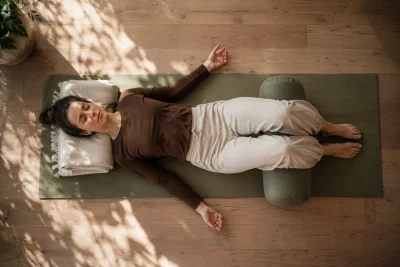
Most home practice is built like a class: warm up, work, brief rest. If sleep is the goal, invert it. Give the closing portion more time than feels reasonable. Ten minutes of savasana rather than three. A seated breath practice at the end rather than a hurried one at the start. The asana is not doing the work here, and treating it as the main event is why so many people practice for months and report better hips and the same 3am.
Then move it. An evening yoga routine aimed at sleep should sit in the hour or two before bed and should feel almost boring. Long exhales. Supported shapes where the floor holds you instead of your muscles. No inversions, no heat-building sequences, nothing that ends with you feeling accomplished. Accomplishment is arousal.
The form that does this most directly is the one the study's winner most resembles. Yoga nidra practice is lying-down guided attention that borrows almost nothing from the athletic tradition, and it sits closer to meditation than to a vinyasa class in everything except its name. We went through what the current nidra research does and does not support, with the same insistence on reading intervals rather than headlines. If you have been curious about it and kept putting it off, this is a reasonable week to start.
Why older adults specifically
The population in this analysis matters. Sleep architecture changes with age. Slow-wave sleep declines, nights fragment, and the drugs typically prescribed for insomnia in later life carry a risk profile that makes almost any non-pharmacological option worth taking seriously. A two-to-three point improvement on a questionnaire reads differently when the alternative carries fall risk.
It also means the finding does not automatically transfer. A 32-year-old whose sleep is wrecked by a phone and a deadline is not the person these 3,568 participants were. The mechanism probably generalizes; the effect size should not be assumed to. The same principle held when this year's International Day of Yoga rebuilt itself around ageing well: research conducted in older populations answers questions about older populations first.
The uncomfortable part for yoga
There is a version of this article that buries the ranking and leads with "yoga improves sleep, new study finds." It would be true. It would also be the kind of reporting that has made wellness research nearly useless to the people who rely on it.
Yoga did not win. It placed second in a four-way comparison, with the loosest estimate in the field, on an outcome it is marketed for constantly. A practice that can survive being told that is a practice worth doing. And the finding is not even a loss so much as a redirection, because the thing that beat yoga is a thing yoga already contains and routinely rushes.
A network meta analysis exists for one purpose. It does not tell you what works. It tells you what works better than the alternatives you were choosing between, which is the only question anyone with limited evening hours is really asking. And the answer, for sleep quality in older adults, is that the still practices are pulling ahead of the moving ones.
What to do this month
September is National Yoga Month, which mostly means a lot of studios will run discounts and a lot of people will restart a practice they abandoned in June. If you are one of them, pick your reason before your class. If the reason is strength or mobility or getting out of the house, book whatever you like. If the reason is that you have been staring at the ceiling since spring, build the month around meditation for insomnia and treat the movement as the warm-up rather than the point.
Try one measurable thing for four weeks. Same wind-down window each night, twenty minutes, mostly still, mostly breath, ending lying down. Write down how long it takes you to fall asleep, roughly, in a notebook rather than a tracker. Four weeks is roughly the shortest interval in the underlying trials, and a notebook will tell you what a wearable cannot, which is how the sleep felt.
The research is telling us something slightly deflating and useful. The part of practice most people treat as the cooldown may be the part doing the work.