Say the phrase "nervous-system regulation" in a yoga studio this year and watch the heads nod. It has become the wellness vocabulary of 2026, printed on tote bags and whispered in workshops, usually with a faint air of the mystical. Strip the mysticism away and something plainer, and far more useful, is sitting underneath. Your teacher was training the vagus nerve decades before anyone thought to sell it back to you.
The gap between the buzzword and the practice is worth closing, because the practice is where the payoff lives. What the internet is calling a breakthrough is, for anyone who has spent time on a mat, mostly a vocabulary upgrade for something yoga has done all along.
The buzzword, decoded
nervous system regulation is, at bottom, the skill of moving yourself out of fight-or-flight and back into calm on purpose. The scientific scaffolding under the trend is the work of researcher Stephen Porges, whose polyvagal theory explained how the vagus nerve governs whether the body feels safe, settled, and able to connect, or braced for a threat that may not be coming. When people talk about "regulating," this is the machinery they mean, even if they have never heard Porges's name.
The reason practitioners keep smiling through the hype is that yoga has always been a set of levers on exactly that machinery. The relationship between the vagus nerve and yoga is not a metaphor. Long exhales, slow breathing, and held restorative shapes all nudge the body toward its rest-and-digest gear, and the research has finally caught up to what people felt on the mat and could not quite name.
Make your exhale longer than your inhale
If there is one thing to carry off this page, it is this. The parasympathetic nervous system, the branch responsible for slowing you down, responds strongly to the out-breath. As Stanford's David Spiegel put it, "Exhalation activates the parasympathetic nervous system, which slows down heart rate." That single mechanism is why extended exhale breathing feels like relief. It is not a feeling you are imagining. It is your physiology changing gears.
The most striking recent evidence comes from a Stanford study published in the journal Cell Reports Medicine in early 2023. Researchers asked 111 people to spend five minutes a day on one of several practices for a month. The standout was cyclic sighing breathwork, a pattern of two inhales through the nose followed by one long, slow exhale, which produced a bigger daily lift in mood than mindfulness meditation and lowered participants' resting breathing rate. Five minutes. No app, no device, no membership. You can read the Stanford summary of the study for the full protocol.
The number to remember: about six breaths a minute
Reviews of slow-breathing research keep landing on a sweet spot of roughly six breaths per minute, a pace that reliably lifts the marker at the center of heart rate variability yoga practitioners have chased for years without the jargon. Higher variability is a sign of a responsive, well-toned system, and slow breathing is one of the most direct ways to train it. Pranayama, it turns out, was interval training for the vagus nerve all along.
What the clinic is finding
This is no longer fringe. A growing body of work shows that yoga and mindfulness-based stress reduction measurably lower physiological stress markers, which is the honest answer to the question of how yoga lowers cortisol: consistent practice appears to bring the stress hormone down over time. And the benefits are not only chemical. In a trial run through the Cleveland Clinic and published in JAMA Network Open, 140 adults with chronic low back pain did twelve weeks of live-streamed hatha yoga. The yoga group saw far larger drops in pain intensity, better function, better sleep, and about 34 percent fewer people still using pain medication, with the gains holding at six months.
Institutions are noticing too. In June 2026, the World Health Organization publicly marked yoga's role in healthy ageing, citing its evidence base rather than its aesthetics. When the WHO and a major hospital system are both pointing at the same practice, the woo framing stops being useful.
A word of proportion is owed here. None of this is a replacement for medical care, and a practice that promised to cure anxiety or heal an injury on its own would be selling something. The honest claim is smaller and sturdier: these tools measurably shift your physiology toward calm, they cost nothing, and they are always available. In a wellness market crowded with gadgets and subscriptions, that combination is rare enough to be worth repeating slowly.
Which shapes actually do the work
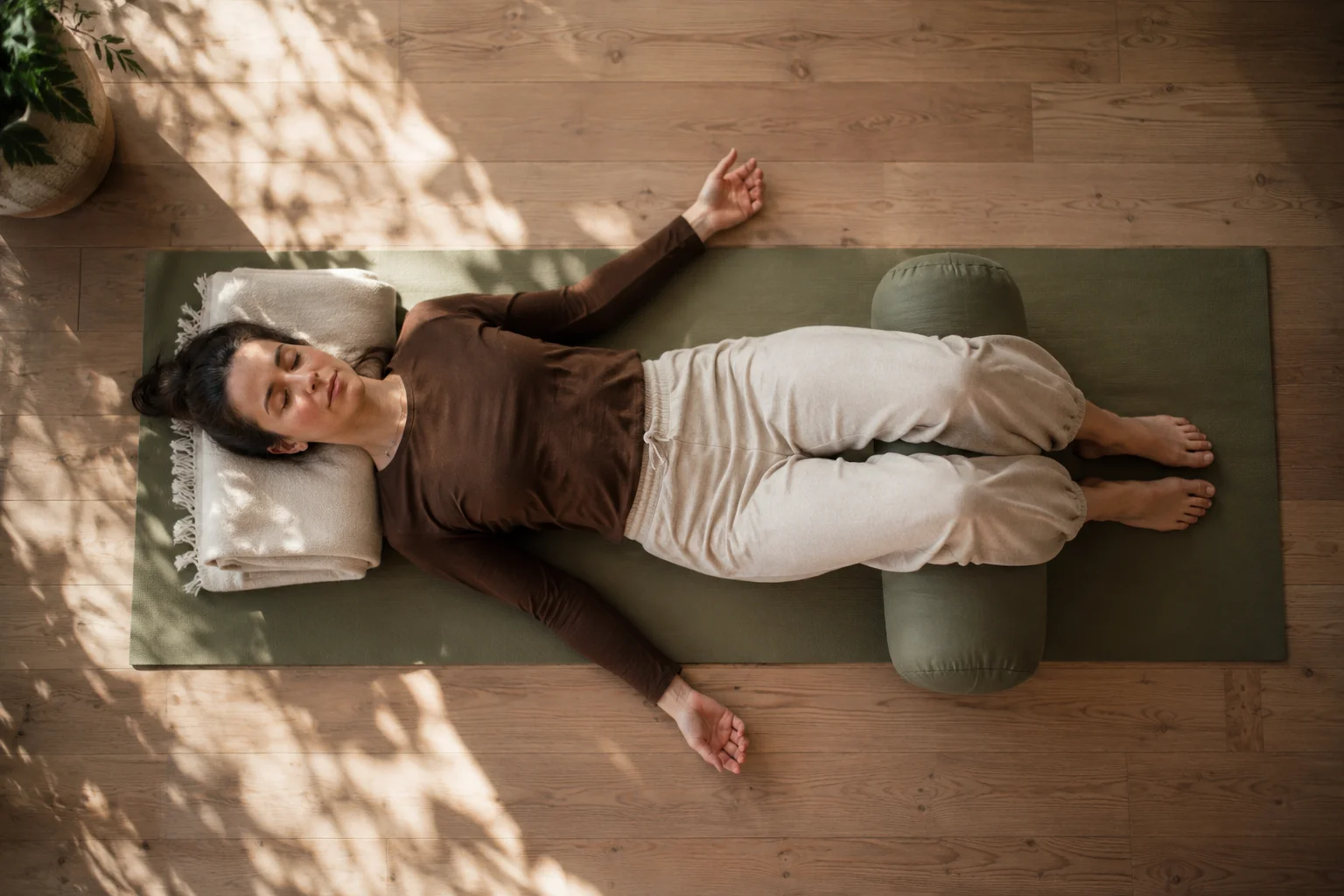
If you want the calming effect without guessing, a few shapes reliably deliver it. Legs up the wall, where you lie on your back and rest your heels against a wall, drains tension from the legs and slows the pulse within minutes. A supported forward fold, draping gently over a bolster while seated, tells the body it is safe to let go. Reclined shapes with a blanket laid over the chest add a light, grounding weight that many people find quietly settling. None of these ask for flexibility. They ask for stillness, which for most of us is the harder skill.
The common thread is the exhale. In every one of these positions, the instruction that changes the physiology is the same: breathe out slowly, longer than you breathe in, and let the shape hold you while you do it. The pose is scaffolding. The breath is the medicine, and the pose is just there to keep you in the room long enough to take it.
Who this helps most
The people who benefit most are often the ones least likely to slow down. Shift workers, new parents, anyone whose day runs on adrenaline and coffee and the next thing on the list. For them, five minutes of deliberate down-regulation is not indulgence but maintenance, the equivalent of letting an overheated engine idle for a moment before you switch it off. It will not fix a stressful life, and it would be dishonest to pretend otherwise. What it does is give the body a reliable exit ramp, one you can take at your desk, on a train, or in the ninety seconds before you walk into a hard conversation.
How to actually do it
None of this requires a headstand. restorative yoga for stress is mostly about getting supported and staying there long enough for the body to believe it is safe. A bolster under the knees, a folded blanket under the head, and five slow minutes in a shape you could hold forever will do more for your nervous system than a sweaty flow you rush through with your shoulders around your ears.
Start with the breath, because it is always with you. Try the cyclic sigh at your desk: two inhales through the nose, one long exhale through the mouth, for two or three minutes. On the mat, favor shapes that let gravity carry the weight, and let each exhale run a beat longer than the inhale. If you want to understand why this body-first approach has taken over studios, our look at the somatic yoga shift traces the same turn toward feeling over performing. And if your stress collects at night, the restorative cousin of these practices deserves its own study; we covered what the latest yoga nidra research shows in a separate guide.
The trend will pass, the way trends do. The mechanism will not. A longer exhale will still slow your heart in 2027 and in 2037, whatever the tote bags say by then. That is the quiet luxury of a practice this old. It was never waiting for science to approve it. It was only waiting for the rest of us to catch our breath.